Executive premise
Most quality organizations treat the intervention log as an administrative artifact. Something operators fill in, reviewers initial, and auditors sample. A record of work performed.
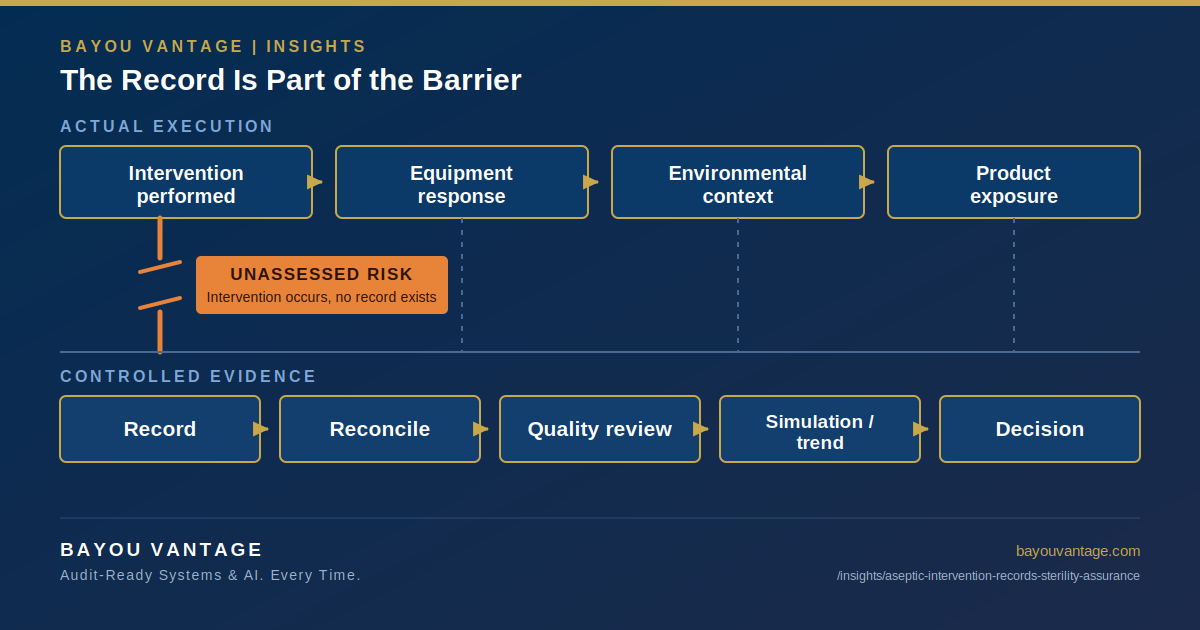
That framing is wrong in a specific and consequential way. In aseptic processing, the intervention record is not a description of the process. It is an input to the process control system itself. It is the only durable evidence of how many times, for how long, and in what manner human activity disrupted the protection around exposed sterile product.
Take it away and a set of downstream controls quietly stop working. Batch record review cannot assess what it cannot see. Contamination investigations lose the ability to time-align a microbial recovery against what was happening on the line. Aseptic process simulations get designed against a fictional intervention profile. Trend analysis cannot identify which interventions recur, so equipment and ergonomic remediation never gets prioritized. And CAPA effectiveness gets measured against training completion, because the operational measure that would actually demonstrate improvement was never captured.
None of those failures announce themselves. The batch record still gets reviewed and released. The investigation still gets closed. The media fill still passes. The system produces every appearance of control while the evidence base underneath it is hollow.
This is why the record is part of the barrier. Not metaphorically. Functionally. The physical barrier limits contamination ingress. The evidentiary record is what allows the organization to know whether the physical barrier held, and to act when it did not.
What FDA confirmed
On August 27, 2026, FDA's Center for Drug Evaluation and Research issued a warning letter to Jabil Inc. of St. Petersburg, Florida, addressed to its Chief Executive Officer. The letter is MARCS-CMS 731037, Reference number 320-26-120, signed by the Director of the Office of Manufacturing Quality, Office of Compliance.
The violations were documented at Pharmaceutics International, Inc. (a Jabil Company), FEI 3006503102, at 103 Beaver Court in Cockeysville, Maryland, during an inspection conducted February 23 through March 6, 2026. FDA reviewed the firm's March 27, 2026 response to the Form FDA 483. FDA determined that because the methods, facilities and controls did not conform to CGMP, the drug products are adulterated within the meaning of section 501(a)(2)(B) of the FD&C Act.
The documented discrepancy
The finding that anchors this article appears under FDA's second violation, a failure to establish adequate written responsibilities and procedures applicable to the quality control unit under 21 CFR 211.22(d).
FDA reported that investigators observed multiple batch records in which operators failed to document most aseptic interventions. The specific example: a batch record for a redacted injection product, dated February 6, 2026, documented that 12 interventions had occurred during filling. FDA stated that records indicated approximately 200 interventions were conducted. FDA further noted that critical interventions, including removing vials from the filling zone and removing fallen vials, were not among those documented. The requirement cited for that element is 21 CFR 211.188.
Limitations of that figure, stated plainly. FDA characterized the larger number as approximately 200, so it is an estimate and should be cited as one. The example is a single batch record on a single date for a product FDA redacted. FDA did not specify which other records indicated the higher figure, and did not state how many additional batch records showed comparable gaps beyond describing them as multiple. None of that weakens the finding, but the finding should be quoted at the precision FDA used, not tightened for effect.
The surrounding findings
The intervention discrepancy did not appear in isolation. FDA documented three violations, and they interlock.
Failure to thoroughly investigate (21 CFR 211.192). FDA reported that the firm, which operates as a contract manufacturer of sterile injectables, failed to adequately investigate a sterility test failure and recurring mold recoveries in the ISO 5 (Grade A) filling area. On the sterility failure, the firm identified the fungus Ustilago spermophora and closed the investigation with a root cause of undetermined. FDA found that inadequate, noting the investigation did not thoroughly examine possible routes of fungal migration through the classified areas, including personnel and material flow hazards, HVAC hazards and inadequate disinfection. The batch was rejected. The investigation lacked adequate CAPA.
On environmental monitoring, FDA cited three excursions. In March 2024, Chaetomium globosum was recovered below a redacted location on a vial machine after filling a batch; FDA found the investigation did not adequately evaluate whether the mold was introduced during filling operations, and the product was released without sufficient investigation. In May 2025, a passive air sample recovered Didymella glomerata during filling and surface monitoring recovered Mycosphaerella africana after a power failure was restored; the investigation lacked sufficient CAPA. In June 2025, Chaetomium cruentum/globosum was recovered from a vial machine after filling; the batch was rejected, and FDA noted the investigation asserted that no mold had historically been isolated in the Grade A space on that line, when the same organism had been recovered on the same line in March 2024.
FDA stated that fungal recovery trends across the suites and supporting cleanrooms had significantly increased since 2023, and that investigations were closed without robust CAPA.
Quality unit oversight (21 CFR 211.22(d)). Beyond intervention documentation, FDA cited failure to adequately evaluate environmental isolates for inclusion in disinfectant efficacy studies, such that the studies did not represent the full spectrum of microbes in the facility, and failure to perform a process validation study after implementing a new production step.
Aseptic procedures and facility condition (21 CFR 211.113(b) and 211.58). FDA reported that airflow visualization smoke studies were not performed after a modification to a barrier system unit, and that the validation department had determined smoke studies were unnecessary despite the firm's engineers proposing that they be conducted. FDA also noted that two interventions, product spillage cleaning at the filling station and a redacted adjustment, lacked adequate smoke to visualize unidirectional airflow.
One sentence in this section deserves separate attention. FDA observed that although the firm characterizes its Grade A processing lines as restricted access barrier systems, their design and operation involve an excessive number of interventions and do not meet the minimum standards of a restricted access barrier system. That is FDA declaring that the intervention burden itself invalidates the barrier classification.
FDA also cited inadequate environmental monitoring technique and insufficient sampling locations, and facility maintenance deficiencies including peeling paint on walls and plastic debris on floors in a Grade C hallway and product transfer room. On the firm's response that the debris was non-viable particulate, FDA noted the response did not explain the basis for asserting paint debris could not harbor microorganisms, nor evaluate whether the paint bubbling and peeling contributed to mold identified throughout the classified areas.
One line to carry into every section below. FDA wrote that procedural updates and training alone do not address the systemic failures that allowed deficient investigations to persist undetected by quality unit oversight. Keep that sentence in view when you reach the CAPA effectiveness section.
Regulatory status caveat. A warning letter describes FDA's findings at the time of issuance and its assessment of the firm's responses as of that date. It is not a final agency action or an adjudication. FDA recommended a teleconference to discuss corrective actions, recommended engagement of a consultant qualified under 21 CFR 211.34, and noted that it may re-inspect. Later regulatory interactions may follow. Nothing in this article should be read as a statement about the firm's current remediation status, its compliance posture today, or the disposition of any batch FDA did not address.
Why interventions matter
The reason regulators focus on interventions is not documentation for its own sake. It is proximity.
An intervention is a moment when a human being, or a tool held by one, enters or acts within the space where sterile product is exposed. Every attribute of that moment is a contamination variable:
Proximity to exposed product. Reaching over an open vial is a different risk than adjusting a component two feet downstream.
Disruption of first air. The unidirectional airflow protecting exposed product is only protective if it reaches the product without interruption. A hand, a sleeve, or a tool placed upstream breaks that path, and the break is invisible without airflow visualization performed under the actual intervention condition.
Operator activity. Personnel are the dominant microbial source in a cleanroom. Movement, reach, posture and duration all change the shedding profile.
Equipment contact. Interventions frequently involve contact with product contact surfaces, which converts a transient hazard into a persistent one.
Duration. A two-second correction and a four-minute recovery are categorically different exposures, and an intervention record that captures the event but not its duration cannot distinguish them.
Recovery. What happened after the intervention. Whether product was rejected, whether the area was re-sanitized, whether the line was allowed to stabilize before filling resumed.
Now hold that list against the arithmetic from the letter. Twelve documented against approximately 200 conducted means the quality system had visibility into roughly six percent of the events that mattered most. Not six percent of process time. Six percent of the moments of greatest contamination vulnerability in the entire operation.
And this is exactly why FDA's remark about barrier classification lands where it does. When intervention volume is high, the barrier is doing less work than its designation implies, and the documentation burden is highest at precisely the moment the organization is least likely to keep up with it.
Build a controlled intervention taxonomy
The remainder of this article is Bayou Vantage analysis. It is a governance framework, not an FDA requirement, and FDA has not reviewed or endorsed it.
You cannot record what you have not defined. Most intervention documentation failures begin as classification failures: operators are asked to log interventions without a shared, unambiguous definition of what counts as one.
A controlled taxonomy should define categories that drive different handling, not categories that merely sort:
Planned interventions. Anticipated, described in the batch record or procedure, occurring at defined points. Component replenishment, sampling, in-process weight checks.
Inherent interventions. Routine to the process and expected to occur, though not at a fixed point. Adjustments the line design makes necessary.
Corrective interventions. Performed in response to a process deviation or equipment condition. Clearing a jam, correcting a misfeed.
Unplanned interventions. Not anticipated by procedure. These carry the highest information value because they identify where the process design is failing.
Critical interventions. Any intervention, regardless of the category above, that involves entry into the Grade A space in proximity to exposed product or contact with a product contact surface. FDA's examples in this letter, removing vials from the filling zone and removing fallen vials, sit here.
Every logged intervention should carry four attributes at minimum: location (which zone, which piece of equipment, which position relative to first air), reason (what condition prompted it), duration (elapsed time, not a category), and operator (attributable to an individual).
Two design tests. First, can two trained operators independently classify the same event the same way? If not, the taxonomy is not controlled and your intervention data is not comparable across batches or shifts. Second, does the taxonomy make the highest-risk category the easiest to identify? If an operator has to reason through a decision tree to determine that removing a fallen vial is critical, the taxonomy is working against the operator under time pressure.
Design contemporaneous capture
Here is the operational reality that most remediation plans fail to confront: recording an intervention contemporaneously, from inside a gowned aseptic operation, at the moment the operator is dealing with the condition that prompted it, is genuinely difficult. Sometimes the act of documenting would itself introduce risk.
A remediation that says operators will document all interventions in the batch record, without changing anything about how or when that is feasible, is a plan to produce the same result more emphatically. This is the single most common failure mode in intervention record remediation, and it is why the discrepancy in this letter is worth studying rather than simply condemning.
Capture design has to satisfy three constraints simultaneously: the record must be contemporaneous, it must be attributable, and creating it must not add aseptic risk.
Controlled alternatives that can satisfy all three, depending on the operation:
A second-person recorder outside the critical zone. The operator performs, a designated observer logs in real time. Attribution is to both. This is often the most practical answer for high-intervention lines and it has the additional benefit of putting a second set of eyes on aseptic technique.
Continuous video with structured post-run reconciliation. The recording is contemporaneous even when the log entry is not, provided the reconciliation is performed against the video within a defined window, by a defined role, under procedure. This should be defined as a controlled alternative in advance, not adopted informally.
Equipment-generated event capture. Where the machine can register door openings, glove port use, stoppages and restarts, those events become an objective spine that manual entries are reconciled against.
Structured pause points. For interventions that do not require an immediate response, a defined moment at which logging occurs, close enough in time to remain contemporaneous.
Whichever method is chosen, define it, validate that it works under actual line conditions including worst-case shift and speed, and specify in procedure what constitutes an acceptable contemporaneous record. An undocumented workaround is a data integrity finding waiting to be written.
Reconcile execution evidence
A single-source intervention record is unverifiable by design. Reconciliation against independent evidence is what converts the log from a claim into a control.
The reconciliation sources available in most aseptic operations:
Batch record entries, the primary log
Equipment event data, door openings, glove port activation, barrier breaches, machine stops and starts
Alarms, pressure differential, airflow, environmental
Downtime records, which frequently capture stoppages that generated interventions never logged as such
Reject and reconciliation data, since vials removed from the line during an intervention should reconcile against yield
Environmental monitoring results, with sample times and locations
Video, where used
Personnel entry and exit records
The controlling principle is simple. Any single source can be incomplete. Divergence between two sources is a signal, and the signal has to go somewhere.
Note how directly this bears on the letter. FDA said the batch record documented 12 while records indicated approximately 200. That comparison was possible because a second evidence source existed. What appears to have been missing was a routine internal process that performed the same comparison before an investigator did.
Build that comparison into batch record review. A reviewer should be asking, for every batch, whether the intervention count in the record is plausible against downtime, reject data and equipment events. A batch on a high-intervention line that logs a small round number of interventions is not reassuring. It is a flag.
Connect the record to process simulation
Aseptic process simulation is only as valid as the intervention profile it simulates. If the media fill runs a modest, orderly set of interventions while routine production runs many times that number under time pressure, the simulation is not qualifying the process being performed.
The intervention record is what supplies the design basis. Without it, simulation design defaults to what the team believes happens, which is systematically optimistic.
Simulation design inputs that should come directly from intervention data:
Routine frequency, derived from the actual distribution across recent batches rather than a procedural estimate
Worst-case sequence, the specific combinations that actually occurred, including interventions clustered in time
Duration, with the simulation covering the upper range observed, not the median
Line speed matched to worst-case production conditions
Shift conditions, including night shift, end of campaign, and reduced staffing
Repeated interventions, where the same intervention recurs on the same batch, which is a distinct and more severe challenge than the same count spread across different types
FDA's finding on the firm's response is directly on point here. FDA stated the response was inadequate because it did not provide sufficient detail on how interventions in aseptic process simulations will be captured, simulated and verified. Those three verbs are the whole requirement. Captured means the production data exists. Simulated means the media fill reproduces it. Verified means someone confirms the simulation actually did so.
A media fill that passes while simulating an intervention profile the line does not experience provides false assurance, and false assurance is worse than no assurance because it terminates inquiry.
Connect the record to investigations
When a microbial recovery occurs, the first analytical question is what was happening on the line at that time. Without an intervention record with times and locations, that question cannot be answered, and the investigation is forced toward one of two bad outcomes: an undetermined root cause, or a causal conclusion the evidence does not support.
Both appear in this letter. FDA found the undetermined root cause on the sterility failure inadequate. FDA also found inadequate the investigation that attributed a mold recovery to a power failure, noting that surface monitoring recovered a different organism after power was restored.
That second one is the more instructive failure. A plausible explanation arrived, and the investigation stopped. The available evidence did not support closure, and evidence pointing elsewhere was present in the same investigation.
Investigation practice that intervention records make possible:
Time-align everything. Put interventions, environmental sample times, equipment events, alarms and personnel movements on a single timeline for the batch. Most investigations that fail on root cause never construct this timeline.
Assess proximity, not just coincidence. An intervention at the sample location shortly before recovery is a different finding than an intervention elsewhere in the suite.
Check history on the same line. FDA noted that the firm's investigation asserted no historical mold recovery in the Grade A space on that line when the same organism had been recovered on the same line the prior year. A search of prior recoveries by organism and location should be a required investigation step, not a discretionary one.
Assess product impact against exposure, not against outcome. FDA found inadequate a response reasoning that product impact conclusions were appropriate based on an absence of sterility failures, adverse trends and complaints. Absence of detected failure is not evidence of absence of contamination, particularly when the detection system itself is under question.
Do not close on plausibility. A hypothesis that fits is not a root cause. Require that alternative causes be examined and excluded on evidence, and require that unexplained findings remain open.
Quality Unit decision rights
FDA placed the intervention documentation finding under the quality unit violation, not under the batch record violation alone. That placement is the argument: the failure was not that operators did not write things down. It was that the quality unit released batches whose records could not support review.
Decision rights that need to be explicit and written:
Completeness is a release criterion. The quality unit does not disposition a batch whose intervention record is incomplete or implausible against reconciliation evidence. This has to be a stated criterion with a stated basis for rejection, because the pressure at disposition always runs toward release.
Unresolved discrepancy escalates and stops the clock. When reconciliation shows divergence that cannot be explained, the quality unit opens an investigation before disposition rather than noting it for trending.
Authority to require additional investigation. The quality unit can reject an investigation as inadequate and require it be reopened, and that authority is exercisable against production and against engineering.
Authority to halt. Where intervention data shows a line operating outside its qualified profile, the quality unit can stop the line. If that authority exists on paper but has never been used on a line with a shipping commitment, it does not exist.
FDA's language in the quality systems section of the letter is direct on this point. The agency found the quality unit was not enabled to exercise proper authority or had insufficiently implemented its responsibilities, and stated that executive management should immediately and comprehensively assess global manufacturing operations. Note the word enabled. That is a statement about what the organization permitted the quality unit to do, and it is addressed to management rather than to the quality unit itself.
Use trends to reduce risk
Complete intervention data has a use beyond compliance, and it is the one that actually reduces contamination risk: it tells you which interventions to eliminate.
Interventions are not a fixed feature of aseptic manufacturing. They are the output of equipment reliability, line design, component quality and ergonomics. A line requiring approximately 200 interventions per batch is telling you something about itself.
Trend analysis that produces action:
Rank by frequency and by criticality separately. The most frequent intervention and the most dangerous one are rarely the same, and both warrant remediation for different reasons.
Attribute to cause. Jams, misfeeds, component variability, sensor faults, operator access difficulty. Each points to a different remediation owner.
Compare across lines, shifts and campaigns. Variation that correlates with shift is an ergonomics or staffing finding. Variation that correlates with component lot is a supplier finding.
Then route to the remediation that actually addresses the cause: equipment redesign, ergonomic improvement to reduce reach and disruption of first air, preventive maintenance where interventions correlate with equipment condition, automation or barrier upgrade where intervention frequency is structural, component or supplier change where material variability drives jams, and procedural change last rather than first.
The order matters. Procedural change is the cheapest remediation and the weakest. It is also the one most likely to appear in a CAPA plan.
Data-integrity safeguards
Intervention records are CGMP records. They carry the same expectations as any other, and the gap between 12 and approximately 200 is a data integrity issue as much as an aseptic one.
Attributable. Every entry traceable to an individual. Where a second-person recorder is used, both the performer and the recorder are identified.
Contemporaneous. Recorded at the time of the activity, or under a defined and validated controlled alternative with a specified maximum interval.
Complete. All interventions, including those that seem trivial and those that occurred during an event the operator would rather not highlight. Completeness is the attribute most affected by culture, and culture is affected by what happens to people who report a high count.
Legible and enduring, in whatever medium is used.
Accurate, which for interventions means duration and location recorded as observed rather than as typical.
Controlled corrections. Late entries and corrections happen. They should be permitted under procedure, marked as such with the reason and the time of entry, and reviewed. An intervention documentation system with no visible late entries anywhere in its history is not a system with perfect performance. It is a system where late entries are being made invisibly.
Audit trail and reconciliation review. For electronic capture, audit trail review is part of batch record review, not a periodic separate activity. For paper systems, the reconciliation against independent evidence sources described above performs the equivalent function and should be documented as a review step.
One cultural safeguard worth stating explicitly because it determines whether everything above works. If operators are evaluated in a way that makes a high intervention count reflect badly on them, the count will come down without the interventions coming down. Separate the two completely. Reward accurate reporting, and route high counts to engineering rather than to the operator.
CAPA effectiveness
FDA supplied the standard in this letter, so use it verbatim as a design constraint: procedural updates and training alone do not address systemic failures.
An intervention documentation CAPA that closes on procedure revised and training completed has verified that a document changed and that people attended. It has verified nothing about whether interventions are now being recorded.
Effectiveness verification has to measure two distinct things.
Record completeness. Over a defined period and a defined number of batches, reconcile documented intervention counts against independent evidence sources. The measure is the divergence between them, and the acceptance criterion is a defined threshold with a defined action if exceeded. This is measurable, it is objective, and it directly addresses the finding.
Operational improvement. Whether the intervention burden is actually decreasing. Complete records showing a stable count of approximately 200 interventions per batch represent a documentation success and a process control failure. Both measures are required, because the first one alone can be satisfied without any reduction in contamination risk.
Supporting criteria that should also be defined at CAPA initiation rather than after:
Investigations opened from reconciliation discrepancies, and their outcomes
Intervention profile used in the most recent aseptic process simulation compared against actual production data
Environmental monitoring recoveries time-aligned to interventions, and whether that alignment is now being performed
Remediation actions generated from intervention trending, by category, showing that trending produced engineering change and not only procedural change
And the discipline that makes any of this real: a CAPA remains open through effectiveness verification. Actions complete and effectiveness verified are different states. A CAPA reported as complete while verification is still running is not complete, and the distinction is one FDA has been explicit about across recent enforcement.
The inspection-ready evidence package
If an investigator asks how you control aseptic interventions, the answer is a package, retrievable, not a narrative. Assemble it before you need it.
Taxonomy. The controlled definition of intervention categories, with criticality criteria, in effect and trained.
Recording method. The defined capture method, the rationale for any controlled alternative, and the evidence that it functions under actual line conditions including worst case.
Reconciliation evidence. Documented comparisons between intervention records and independent sources, for a meaningful sample of batches, with the disposition of every divergence found.
Intervention trend. Frequency and criticality trending by line, shift and campaign, over a period long enough to show direction.
Simulation rationale. The documented link from production intervention data to media fill design, showing frequency, worst-case sequence, duration, line speed and shift conditions, with verification that the simulation executed as designed.
Investigation linkage. Examples of investigations where intervention records were used to time-align and evaluate contamination events, including at least one where the record excluded a hypothesis.
Effectiveness results. Completed effectiveness verification against both completeness and operational improvement criteria, including any verification that failed and what followed.
The package should be assembled by someone who did not build the system, and it should be tested against a single question: does this evidence show control, or does it show documentation about control?
Questions for executive leadership
The distinction leadership most needs to be able to make is between documentation completeness and actual process control. These questions are built to separate them.
On our highest-intervention line, how many interventions occur in a typical batch, and what is the source of that number? If the answer comes from the procedure rather than from data, we do not know.
When did we last reconcile documented intervention counts against equipment events, downtime and reject data? What was the divergence?
Does our aseptic process simulation reproduce the intervention profile of actual production, and who verified that it did?
In our last three contamination investigations, did we construct a timeline aligning interventions with environmental results and equipment events? If not, on what basis did we determine root cause?
Has an investigation in the past two years been closed on a plausible explanation without excluding alternatives on evidence?
Has the Quality Unit ever rejected a batch, halted a line, or reopened an investigation over intervention documentation? If not, is that because the situation never arose or because the authority is not real?
What has intervention trending caused us to change about our equipment, our line design, or our ergonomics? If the answer is only procedures and training, the trending is not being used.
Are our operators evaluated in any way that makes reporting a high intervention count personally costly?
If intervention documentation improved to complete tomorrow, would our intervention count go down, or would we simply have accurate records of the same risk?
Question nine is the executive question. Documentation completeness and process control are different achievements, and only one of them protects patients.
Primary sources, limitations and fact/analysis separation
Primary source
U.S. Food and Drug Administration, Center for Drug Evaluation and Research. Warning Letter, Jabil Inc., MARCS-CMS 731037, Reference number 320-26-120, August 27, 2026. https://www.fda.gov/inspections-compliance-enforcement-and-criminal-investigations/warning-letters/jabil-inc-731037-08272026
Supporting FDA references cited within the letter
FDA guidance, Sterile Drug Products Produced by Aseptic Processing: Current Good Manufacturing Practice. https://www.fda.gov/media/71026/download
FDA guidance, Quality Systems Approach to Pharmaceutical CGMP Regulations. https://www.fda.gov/media/71023/download
21 CFR parts 210 and 211, in particular 211.22(d), 211.42(c)(10)(v), 211.58, 211.100(a), 211.113(b), 211.188 and 211.192
What is fact and what is analysis
All statements attributed to FDA in the section titled What FDA confirmed, including the intervention counts, the microbial identifications, the inspection dates, the regulatory citations and the requested remediation, are drawn solely from the warning letter linked above. Every other section of this article, including the intervention taxonomy, the capture design options, the reconciliation model, the simulation linkage, the investigation logic, the Quality Unit decision rights, the effectiveness criteria, the evidence package and the leadership questions, is Bayou Vantage analysis. FDA has not reviewed, endorsed or adopted any of it.
Limitations
The intervention figure of approximately 200 is FDA's own characterization and is an estimate. The comparison is drawn from a single batch record dated February 6, 2026 for a product FDA redacted. FDA described comparable gaps in multiple batch records but did not quantify them. Product identifications, equipment identifications, room designations, customer identity and several process details are redacted in the letter as (b)(4), and this article does not speculate about any of them.
A warning letter reflects FDA's findings at the time of issuance and its evaluation of the firm's responses as of that date. FDA recommended a teleconference on corrective actions, recommended engagement of a consultant qualified under 21 CFR 211.34, and noted it may re-inspect. This article makes no claim about the firm's current remediation status, its compliance posture today, or the disposition of any batch FDA did not address.
Verify before relying on this. FDA warning letter pages are updated and letters may be closed out. Check the source directly.
Discuss your readiness needs
Can your inspection-readiness evidence show that aseptic execution and the batch record are aligned?
Bayou Vantage can help structure a focused review of intervention controls, investigation evidence, CAPA effectiveness and Quality oversight.