Executive premise
Accelerated clinical development does not accelerate CMC. It accelerates the date by which CMC has to be finished.
That distinction is the whole problem. A breakthrough designation moves the submission date forward. It does not shorten the time required to run a stability program, qualify a commercial facility, transfer a process to a contract site, complete process performance qualification, or build launch inventory. Those durations are governed by physics, by regulatory expectation, and by the availability of a facility that may not yet exist. They do not compress because the clinical data arrived early.
So the program ends up with a fixed set of long-duration CMC activities and a submission date that moved toward them. The arithmetic is unforgiving, and it is usually not done until late.
What makes this failure mode persistent is that it hides well. Each function reports status honestly. Analytical says method qualification is on track. Manufacturing says the tech transfer plan is drafted. Facilities says the suite is in design. Regulatory says the submission strategy is aligned. Every answer is true. None of them answers the question that matters, which is whether the longest chain of dependent tasks still fits between today and the submission date, and what happens to the chain if any single link slips.
FDA has said as much. In its strategy document on facilitating CMC readiness for products with accelerated clinical development, the agency states that products with accelerated clinical development often face challenges in expediting CMC development activities to align with the accelerated clinical timelines, and that overcoming those challenges often requires additional interaction with FDA during product development.
Read that as a diagnosis. The agency is not describing a paperwork problem. It is describing a sequencing problem, and sequencing problems are solved with a critical path, not with a task list.
What opened October 1
On September 21, 2026, FDA published a program announcement in the Federal Register for the Chemistry, Manufacturing, and Controls Development and Readiness Pilot, known as the CDRP, under docket FDA-2022-N-2396. FDA began accepting year-five requests on October 1, 2026.
This is a continuing pilot, not a new one. The CDRP has run since 2022 under PDUFA VII. What opened on October 1 is the fifth year of requests.
Purpose. Per FDA, the pilot is intended to facilitate expedited CMC development for products that already have expedited clinical development timeframes, by increasing communication between FDA and the sponsor during development.
Participation is narrow. FDA states it will select no more than nine proposals per fiscal year, allocated approximately two-thirds to CBER-regulated products and one-third to CDER-regulated products.
Eligibility. Per the program announcement, candidates need an active commercial IND, submission in eCTD format unless waived, sufficient time remaining before the marketing application, and a demonstrated commitment to CMC development. On the CBER side, FDA describes existing INDs for cellular and gene therapies or vaccines holding Breakthrough Therapy or RMAT designation. On the CDER side, FDA describes existing INDs with an expedited development timeframe, including those with Breakthrough Therapy or Fast Track designation. Combination products are eligible, though FDA indicates that complex ones are less likely to be selected.
How a request is made. The sponsor submits a written IND amendment with a cover letter requesting participation in the CMC Development and Readiness Pilot, identifying a point of contact and the expedited designation, and including a CMC Development Plan.
The meeting model. Selected participants receive two predesignated CMC-focused Type B meetings with an assembled FDA review team, together with expanded CMC discussion and follow-up for clarification.
Selection. FDA acknowledges and reviews requests on receipt and issues an acceptance or denial letter within 90 days. FDA describes its selection factors as including the potential clinical benefit of the product, product novelty, manufacturing complexity and anticipated challenges, while seeking balance across product types.
The closing window. In its strategy document, FDA states that as PDUFA VII draws to a close it will stop accepting new applications for admission to the CDRP at the end of April 2027, though the program will continue for INDs previously accepted. Taken with the October 1 opening, that leaves roughly seven months of application window and no more than nine selections in the fiscal year.
What the pilot is not. Participation is not approval, and it is not a commitment by FDA to any outcome. Selection is not guaranteed for any sponsor who applies. Nothing in the pilot relaxes CMC evidence expectations, CGMP compliance, or the quality expected of a marketing application. The pilot adds structured interaction. It does not substitute for readiness, and a sponsor who enters it unprepared will simply be unprepared in front of a review team earlier.
What FDA asks the sponsor to make visible
The remainder of this article is Bayou Vantage analysis. FDA's submission-content expectations are described above and in the linked sources. The operating model, the governance structure, the diagnostic and the executive questions that follow are ours. FDA has not reviewed, endorsed or adopted them.
Set aside whether you intend to apply. The CMC Development Plan that FDA asks for is a useful specification in its own right, because it is a list of the things an executive team should be able to produce about any accelerated program.
Per the program announcement, that plan covers remaining CMC tasks with estimated timeframes, product characterization and critical quality attributes, the drug substance and drug product manufacturing processes, the commercial-scale manufacturing strategy, plans for identifying facilities, assurance of product availability, the stability assessment plan, the process validation strategy, an analysis of anticipated challenges, and proposed timing for the first Type B meeting.
Translate that into the executive view, and four questions fall out:
What is left, and how long does each piece take? Not what is in progress. What remains, with a duration attached to each item, including the items nobody has started.
Where will this be made, at commercial scale, and is that place ready? Facility identification is called out separately from manufacturing process for a reason. The process can be defined while the site is not.
Will there be product on the day of approval? Product availability assurance is a supply question, not a manufacturing question, and it depends on validation, release testing capability, and material lead times that run independently of the submission.
What do you already know will go wrong? The anticipated challenges item is the one most often answered thinly. A sponsor that cannot name its three most likely CMC failure points has not done the analysis.
The organizations that handle accelerated programs well can answer all four in a single session, with evidence. The organizations that struggle convene a cross-functional meeting to assemble the answer, and discover in that meeting that the functions disagree.
Replace the task list with a critical path
A task list tells you what is being worked on. A critical path tells you what the submission date actually depends on. They are not the same artifact and one does not become the other by being sorted.
For every remaining CMC item, five fields:
Field What it captures Owner A named individual, not a function. Functions cannot be held to a date. Evidence The specific record that will exist when this item is complete, and which part of the application it supports. Dependency What must finish before this can start, and what cannot start until this finishes. Latest responsible decision date The last date a decision can be made without moving the submission. Submission consequence What happens to the filing if this item is late.
The fourth field is the one that changes behavior. Teams track due dates, which are negotiable and slip quietly. The latest responsible decision date is derived backward from the submission and from everything downstream of the item, so it cannot be renegotiated without someone explicitly accepting a later filing. That converts a scheduling conversation into a governance decision, which is where it belongs.
The fifth field prevents false equivalence. Not every late item delays the submission. Some consume float, some degrade the quality of a section, some remove an option that was being held in reserve. Writing the consequence down separates the items that matter from the items that are merely visible.
Two tests for whether you have a critical path or a decorated task list. First, can you name the single longest dependent chain between today and the submission date, end to end? If not, you have a list. Second, when one item slips a month, can you say within a day which other items move and whether the filing date moves? If that answer takes a week of meetings, the dependencies are not recorded anywhere, they are distributed across people's heads.
Product knowledge and control strategy
Everything downstream of this section depends on it. A control strategy is the argument that the commercial process will reliably produce material with the attributes that matter to the patient. It is assembled from product knowledge, and product knowledge accumulates on its own schedule.
The chain runs from critical quality attributes, through the process understanding that explains what affects them, to the specifications that bound them, to the analytical methods that measure them, to the control points that keep the process inside those bounds.
On an accelerated program the characteristic failure is that this chain is built for the clinical process and then inherited by the commercial process without being rebuilt. The CQAs usually survive the transition. The process knowledge often does not, because it was developed at a different scale with different equipment. Specifications set from a small number of clinical lots carry limited process capability information, and they become difficult to defend when commercial-scale variability appears.
Practical governance points:
Specifications need a stated basis, not just a number. Clinical experience, process capability, stability behavior, and clinical relevance each justify a limit differently. A specification whose basis is "what the clinical lots did" is a placeholder.
Method readiness is a gating item, not a parallel one. Validated methods are required for the commercial control strategy, for stability, for comparability and for release. A method that is still being developed blocks several chains at once.
Comparability is a planned exercise. When the commercial process differs from the clinical process, and it almost always does, comparability is the bridge that lets clinical data support the commercial product. It needs a protocol, methods capable of detecting the differences that matter, and material from both processes.
Clinical-to-commercial differences
The gap between the process that made clinical material and the process that will make commercial material is where most accelerated CMC risk is concentrated, and it is frequently discussed in aggregate rather than itemized.
Make it explicit, dimension by dimension:
Scale. Not only batch size. Mixing, heat transfer, hold times and shear change with scale, and they change differently for different modalities.
Equipment. Different vendors, different materials of construction, single-use versus stainless, different control systems.
Process. Steps added, removed, reordered, or reparameterized. Each change needs a rationale and an impact assessment against the CQAs.
Site. A different building, a different quality system, different personnel, different utilities and environmental conditions.
Raw materials. Different suppliers, different grades, different lot sizes, and in some cases a different regulatory status for the material itself.
Microbial control. Different facility classification, different flow of personnel and materials, different bioburden and endotoxin control, different sterilization or filtration approach.
Analytical methods. Transferred to a different laboratory, or changed outright between clinical and commercial.
For each difference, three items belong in the record: what changed, what the risk to product quality is, and what evidence closes it. Comparability data, process characterization, additional validation, or a documented rationale that the change is immaterial.
The failure mode here is not that organizations ignore these differences. It is that the differences are known individually by the people closest to them and never assembled into one list that an executive can read. That list is short, it fits on a page, and the act of writing it usually surfaces at least one difference nobody had assigned to anyone.
Facility and external-network readiness
Facilities and external partners carry the longest lead times on most accelerated programs, and they are the dependencies least responsive to urgency. A stability study can sometimes be designed around. A facility that is not qualified cannot be hurried past qualification.
The dependency chain to govern:
Site selection determines everything downstream, and late site selection is the single most common cause of compressed CMC timelines. Until the site is chosen, tech transfer cannot start, qualification cannot be scheduled, and the validation plan is hypothetical.
Contract facilities add a layer that many sponsors underestimate. The sponsor remains accountable for the quality of the product regardless of who manufactures it. That accountability requires visibility into the partner's change control, deviation handling and qualification status, which has to be established through the quality agreement rather than assumed.
Technology transfer is a program, not a handoff. Process description, analytical method transfer, engineering runs, person-in-plant arrangements, and a documented acceptance of transfer each take time and each can fail.
Quality agreements need to be in place before the work starts, not papered afterward. The agreement defines decision rights: who may change what, what must be notified and when, what evidence accompanies a notification, and what audit and access rights the sponsor holds. An agreement that covers only materials and labeling leaves the sponsor blind to the changes most likely to matter.
Qualification and validation at the site follow a sequence that cannot be collapsed, and they depend on the facility being complete, the utilities being qualified, and the equipment being installed.
Inspection readiness is the final gate. A pre-approval inspection evaluates whether the facility can reliably make this product, and it evaluates the quality system around it. A site that is technically capable but has an immature quality system is an approval risk that sits entirely outside the sponsor's own walls.
The governance question for executives is simple and uncomfortable: for every facility in the network, internal and external, what is the latest date it can be ready without moving the submission, and who confirmed that date against the facility's own schedule rather than against the program's hope?
Analytical and stability readiness
Stability is the dependency with the least give in the entire program, because it runs in real time and cannot be compressed by adding resources.
The sequence that has to be planned backward from the submission:
Methods must be developed and validated before the stability program that will support the application can begin, because data generated with a method that later changes may not be usable.
Reference standards and materials must be qualified, with a plan for their own lifecycle, since a standard that expires mid-program creates a bridging exercise nobody scheduled.
Specifications must be set, with a stated basis, because stability acceptance criteria derive from them.
Comparability must be executed if the commercial process differs from the clinical process, and the methods must be capable of detecting the differences that matter.
Stability then runs on registration lots made by the commercial process at the commercial site, and the duration required is a function of the shelf life being sought and the stability data expected at submission.
The arithmetic worth doing early: count backward from the submission date through the stability duration required, the time to make registration lots, the time to qualify the site that makes them, and the time to validate the methods that test them. If that chain starts before today, the program has a problem that no amount of parallel effort will solve, and the honest response is to change the submission date, reduce the shelf life sought, or change the plan.
Doing that arithmetic late is how programs arrive at a filing with a stability package that constrains the label.
Validation and supply at approval
Approval and availability are different events, and treating them as the same one is a recurring executive error.
The chain between them:
Process performance qualification requires the commercial process, the commercial site, qualified equipment, validated methods and available materials. It is the convergence point for nearly every other lane, which makes it the item most exposed to upstream slippage.
Facility readiness means qualified, staffed, trained and operating under a mature quality system, not merely built.
Material availability depends on supplier lead times that are set by the supplier, not the program. Long-lead raw materials, single-source components and specialized containers each need their own lead-time entry on the critical path.
Release capability means the quality control laboratory can run every release method, with qualified analysts, qualified instruments and an approved specification, at the commercial site or at a qualified contract laboratory. A product that cannot be released is not available.
Inventory strategy is the decision about how much product to make before approval, and it is a genuine risk-and-capital tradeoff that belongs to executives rather than to the CMC team. Building inventory ahead of approval commits money to a product that may not be approved. Not building it means approval without supply.
The question to ask in governance: on the day of approval, what quantity of releasable product exists, where is it, and what is the evidence that it can be released? If the answer depends on a PPQ that has not been scheduled or a method that has not been validated, the program has an availability gap regardless of its regulatory position.
Decision-ready regulatory engagement
If a sponsor is selected for the pilot, it receives two predesignated CMC-focused Type B meetings with an assembled FDA review team. Two. That scarcity is the point, and it applies equally to any scarce regulatory interaction, pilot or not.
A meeting consumed by a status update is a meeting spent. What converts a meeting into progress is bringing decisions rather than descriptions.
A decision-ready package contains four things for each question:
The evidence. What is known, from what data, with what limitations stated plainly. A limitation the sponsor identifies is credibility. A limitation the review team identifies is a finding.
The alternatives. The options actually considered, with the tradeoffs between them. A single proposed approach with no alternatives suggests the analysis was not performed.
The residual risk. What remains uncertain after the proposed approach, how large that uncertainty is, and what would be done if it resolves unfavorably.
The sponsor's recommendation. A clear statement of what the sponsor intends to do and why. Asking the agency to choose from an undifferentiated menu transfers a decision that belongs to the sponsor.
Two practical disciplines. Sequence the questions against the critical path, so the meeting addresses the items with the earliest latest-responsible-decision dates rather than the items the team finds most interesting. And prepare for the answer you do not want, because the value of a meeting is largely determined by whether the program has a plan for an unfavorable response.
Executive governance
Everything above fails without a governance structure that does three things: sets thresholds in advance, locates authority clearly, and reconciles the functional plans on a cadence.
Escalation thresholds, defined before they are needed. A threshold set in advance is a control. A threshold set during the slip is a negotiation. Useful thresholds include: any movement in a latest responsible decision date, any facility or partner date confirmed later than the program's assumed date, any stability or comparability result outside expectation, any supplier lead-time change on a long-lead item, and any difference between clinical and commercial process newly identified after the plan was set.
Risk-acceptance authority, named and bounded. Accelerated programs require accepted risk, and the question is not whether to accept risk but who may accept which risks. At minimum: which risks a program leader may accept, which require the executive quality leader, which require the executive team, and which cannot be accepted at all because they create a compliance exposure rather than a schedule exposure. Risk accepted by default, because nobody escalated, is the most expensive kind.
A reconciliation cadence. The four lanes, product and analytical, process and control, site and network, regulatory and supply, each maintain their own plan, and those plans drift apart between meetings. The reconciliation is not a status round-robin. It is a working session with one question: do these four plans still describe the same program, on the same dates, with the same assumptions? The output is a list of the places where they disagree, which is the only place new risk actually appears.
One structural note. The CMC critical path should be owned by a single named individual with the standing to convene all four lanes. Where it is owned by a committee, it is owned by nobody, and the reconciliation that matters never happens.
The 30-day diagnostic
Do not build the full model across the portfolio. Test whether it exists on one program.
Select one accelerated program. The one closest to its submission, because that is where the arithmetic is least forgiving and the findings are most actionable.
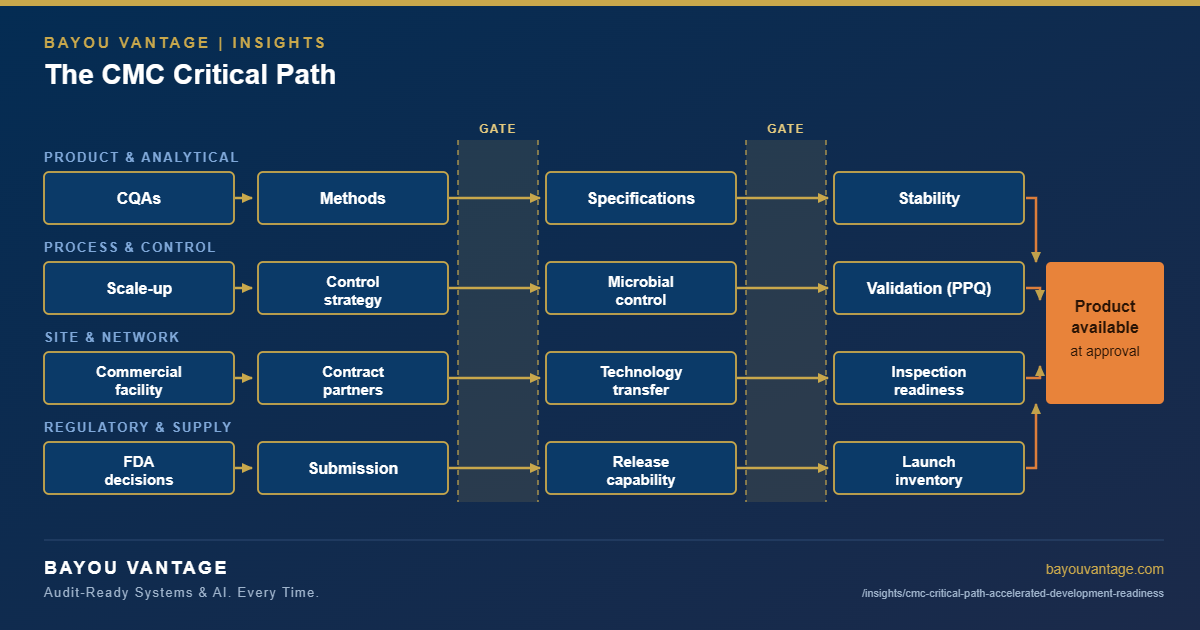
Build the one-page critical-path map. Four lanes, left to right, from today to product availability at approval:
Product and analytical: CQAs, methods, specifications, stability
Process and control: scale-up, control strategy, microbial control, validation
Site and network: commercial facility, contract partners, technology transfer, inspection readiness
Regulatory and supply: FDA decisions, submission, release capability, product available at approval
Mark the gates where lanes converge. PPQ is the obvious one. There are usually three or four others, and finding them is half the value of the exercise.
Populate five fields for each remaining item. Owner, evidence, dependency, latest responsible decision date, submission consequence. Items that cannot be populated are the finding, not a gap in the exercise.
Challenge the five highest-risk dependencies. Rank by the length of the chain behind them and by how little float sits in front of them. For each, put three questions to the owner: what is the evidence that this date is achievable, who outside this room confirmed it, and what is the plan if it slips by one month.
Expect four patterns. A date confirmed by the program rather than by the party who has to meet it. An item with no named owner, usually at a lane boundary. A dependency that runs backward, where something downstream was assumed to be able to start earlier than its predecessor can finish. And a latest responsible decision date that has already passed without anyone noticing.
What to do with the result. If the map completes and the five dependencies survive challenge, the program is in control and the output is a governance artifact worth maintaining. If the map cannot be completed, that is the finding, and the response is to establish ownership and reconciliation before adding any further activity. More parallel work on an unmapped critical path produces motion, not progress.
Can your leadership team show the evidence, dependency and latest responsible decision date for every item on the CMC critical path? Contact Bayou Vantage about a focused CMC-readiness and Quality-operating-model review.
Primary sources
U.S. Food and Drug Administration. Chemistry, Manufacturing, and Controls Development and Readiness Pilot Program; Program Announcement. Federal Register, September 21, 2026, document 2026-19277, docket FDA-2022-N-2396. Year-five requests accepted beginning October 1, 2026. Federal Register notice
U.S. Food and Drug Administration. Strategy Document on Facilitating Chemistry, Manufacturing, and Controls Readiness for Products with Accelerated Clinical Development. Source of the statement that FDA will stop accepting new CDRP applications at the end of April 2027 while continuing the program for previously accepted INDs. Strategy document
U.S. Food and Drug Administration. Chemistry, Manufacturing, and Controls Development and Readiness Pilot (CDRP) Program. Program page. CDRP program page
Fact and analysis separation. FDA's eligibility criteria, submission-content expectations, meeting model, selection process and program dates are drawn from the sources above. The critical-path model, the five-field item record, the latest-responsible-decision-date concept, the four-lane map, the governance structure and the 30-day diagnostic are Bayou Vantage analysis. FDA has not reviewed, endorsed or adopted them.
Limitations. Program details may change, and FDA's program page and the Federal Register notice govern over any summary. Participation in the pilot is not guaranteed to any sponsor, is not an approval, and does not relax CMC evidence expectations, CGMP compliance, or application-quality expectations. Nothing here should be read as a prediction of any meeting outcome, selection decision, or approval. Verify current program status with FDA before acting.
CMC readiness review
Can your leadership team show the evidence, dependency and latest responsible decision date for every item on the CMC critical path?
Bayou Vantage helps biopharma organizations build the critical-path view, locate the dependencies that actually govern the submission, and establish the governance that keeps the four lanes reconciled.
Contact Bayou Vantage about a focused CMC-readiness and Quality-operating-model review.