Why this letter is more than a list of observations
Source boundary, stated up front. Every factual statement about Unilam in this article comes from FDA's warning letter of September 22, 2026, CMS #738562. A warning letter reflects FDA's observations and the agency's position at the time of issuance. It is not a final adjudication, it does not establish that the violations are proven, and the firm's corrective actions were in progress when it was written. Nothing here is a statement about the company's current compliance status. The analytical model, the five properties, the diagnostic and the executive questions are Bayou Vantage analysis, clearly separated below, and FDA has not reviewed or endorsed them.
Now the substance.
The letter addresses a UV sunlamp product, and it spans an unusually wide set of domains for a single inspection: risk management, design and development documentation, supplier evaluation, supplier change notification, monitoring and measurement equipment, product characteristic monitoring, and radiation performance standard testing under 21 CFR Parts 1010 and 1040.
The instinct on reading a letter with that breadth is to treat it as a quality system that was broadly immature. That reading is available and it may even be right. It is also not useful to anyone running a mature system, because the obvious conclusion is "we are not like that," and the letter gets filed.
The more useful reading is narrower. Look at what connects the findings. In each domain FDA is describing a control that exists and does not operate. A risk analysis was performed; it did not reach the hazard that mattered. Suppliers were evaluated; the criteria were not established first. A change notification requirement was put in place; it was not binding. Equipment was calibrated; the acceptance range did not cover what the product actually does. A sampling plan was applied; its basis was never justified.
That is not a maturity problem. That is a handoff problem, and handoff problems appear in mature systems too. They are simply harder to see there, because every individual procedure passes review.
The five properties of an operational control
This section and those that follow it are Bayou Vantage analysis.
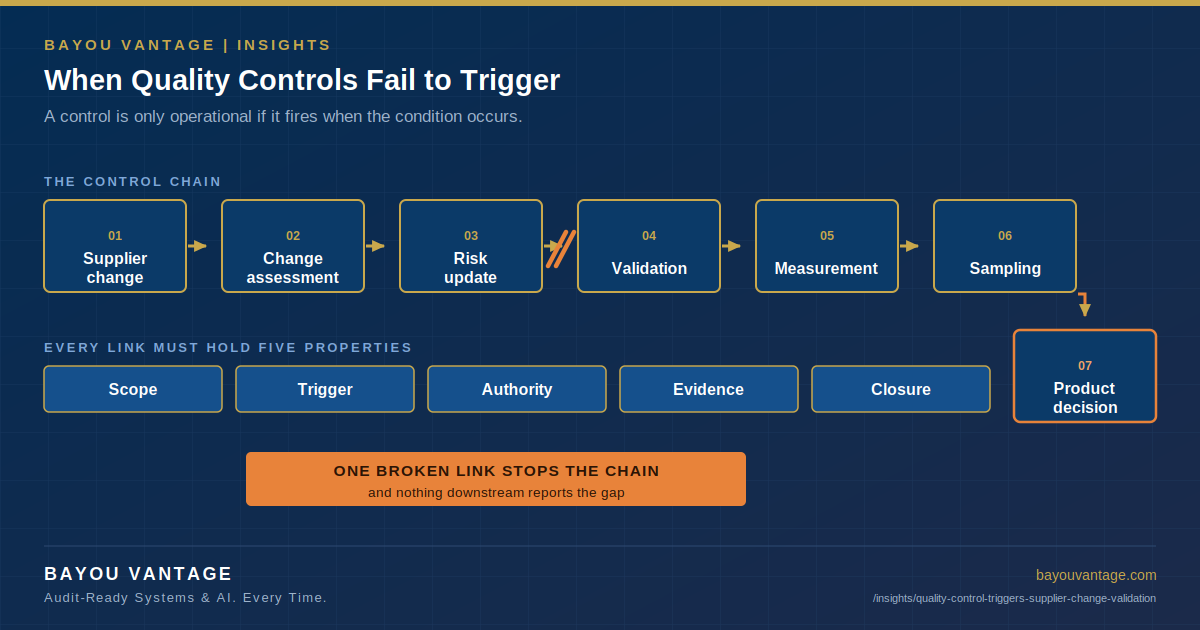
A control that exists is not the same as a control that works. Five properties separate them, and a control missing any one of them will pass a procedure review and fail in practice.
Scope. The control covers the conditions that can foreseeably occur and the lifecycle stages where they occur. A control scoped to normal operation does not cover the failure mode. A control scoped to initial qualification does not cover the device at end of life.
Trigger. A defined event reliably initiates the required assessment. This is the property most often missing, because it is the one nobody owns. A procedure says what to do when a change occurs. It rarely says how the organization learns that the change occurred, and that gap is invisible until something changes without anyone being told.
Authority. Ownership and approval rights are unambiguous, internally and contractually. Internally, that means a named role can require the assessment and can stop the product. Contractually, it means the supplier is obligated rather than asked.
Evidence. Methods, acceptance criteria, sample rationale and records support the decision that gets made. Evidence assembled after the result is known is not evidence of a decision, it is a justification of one.
Closure. The result reaches product disposition, and where the control failed, it reaches product and data already affected. A control that produces a finding which never touches a release decision has not closed.
Test any control you own against those five. The common failures are specific: broad scope with no trigger, clear trigger with no authority to act on it, strong evidence that never reaches disposition.
Risk management must see beyond the label
What FDA reported. Per the letter, FDA found the firm's risk management inadequate under ISO 13485:2016 Clause 7.1. The design failure mode and effects analysis addressed only four risk items. FDA reported that the firm relied on labeling rather than design controls, and that foreseeable risks were not addressed, naming chemical exposure in the event of lamp breakage as an example. FDA also assessed the firm's response and found that the updated DFMEA still lacked analysis of chemical exposure from breakage, and that risks were accepted at medium levels without the approvals the firm's own system required.
The analytical point. There is a difference between cataloguing known failure modes and evaluating reasonably foreseeable hazards, and it is the difference between a risk file that documents what the team already thought of and one that does the work.
A DFMEA with four items is not evidence of a simple product. It is evidence of a narrow question. The question that produces a short list is "what could go wrong with the design." The question that produces a complete one is "what could happen to a person, in any foreseeable condition, including conditions where the device is damaged, misused, at end of life, or outside the environment we assumed."
Breakage is the canonical example precisely because it falls outside normal operation. A lamp that breaks is no longer performing its function, so a hazard analysis organized around function may never reach it. A hazard analysis organized around the user and the environment reaches it immediately.
On labeling as a control. The risk control hierarchy is not a preference, it is an ordering. Eliminate or reduce the risk by design first. Add protective measures in the device or the manufacturing process second. Provide information for safety, which means labeling, warnings and instructions, last.
Labeling is the weakest control for reasons that are easy to state and easy to forget. It depends on the user reading it, understanding it, remembering it, and being in a position to act on it at the moment it matters. None of those conditions holds reliably, and in a breakage scenario none of them holds at all.
The governance question is not whether labeling appears in your risk file. It is whether you can show, for each risk where labeling is the control, a documented rationale for why design and protective measures were not practicable. If that rationale does not exist, labeling was not chosen as a control. It was chosen as an exit.
Against the five properties. Scope failed: foreseeable conditions were not covered. Authority failed: risks were accepted without the approvals the firm's own procedure required, which is a control failing against its own terms.
Change control must activate the evidence system
What FDA reported. Under ISO 13485:2016 Clause 7.3.1, FDA found design and development documentation deficient. Per the letter, validation plans lacked methods, acceptance criteria and sample size rationale. Design change control procedures were not documented. UVC emissions data was incomplete across the device's 800-hour lifetime. In assessing the response, FDA reported that a new procedure had been created but still lacked UVC emissions data across the full lifetime, that specification changes were unexplained, and that there was no evidence the procedure had been applied after implementation.
The analytical point. That last item is the one to sit with. A procedure that exists and has not been applied is a specific and common failure, and it is worse than no procedure, because it creates documented awareness of a requirement that the organization then did not meet.
A change should initiate a sequence, and the sequence should be automatic rather than discretionary:
Change identified, from any source, including a supplier
Impact assessment against the design inputs, outputs and interfaces the change touches
Risk file updated before implementation, not after
Verification or validation determined, executed, and evaluated against predefined criteria
Regulatory assessment of whether the change affects the marketing authorization
Documents updated, including specifications, drawings, procedures and labeling
Release authorization by defined authority, with the above complete
Three structural points govern whether that sequence actually runs.
Predefined is the operative word in step four. Methods, acceptance criteria and sample size rationale written before the test are a plan. Written afterward, they are a narrative. FDA's finding here names all three as missing, which is the signature of validation performed as an activity rather than as a decision.
Lifetime is a scope question. Emissions data that covers the beginning of life and not the full 800 hours is scoped to the wrong lifecycle stage. The question a performance claim has to answer is whether the device meets its specification throughout its stated life, not whether it meets it when new.
Unexplained specification changes are a trigger failure. A specification that changed without a recorded rationale means something moved through the system without initiating the sequence. That is the clearest possible evidence that the trigger is not wired.
Supplier governance requires enforceable notification
What FDA reported. FDA cited two separate supplier findings.
Under Clause 7.4.1, FDA found that purchasing procedures failed to establish supplier selection criteria beforehand. In assessing the response, FDA reported that a quartz tube supplier had scored at the minimum threshold yet was marked "Not Registered," which FDA noted as contradictory, and that a mercury supplier evaluation form was unclear as to which entity had actually been evaluated.
Under Clause 7.4.2, FDA found no written change notification agreements with the quartz tube, mercury and krypton suppliers. In assessing the response, FDA reported that the firm's updated purchase order form contained what the agency characterized as a one-sided request rather than a binding mutual agreement, and that it was less comprehensive than the firm had described.
The analytical point. That characterization is the most transferable sentence in the letter, and it applies to a great many supplier programs that would otherwise consider themselves in good shape.
A request and an obligation are different instruments. A line on a purchase order asking a supplier to notify you of changes creates no duty, carries no consequence, survives no personnel change at the supplier, and binds nobody at the supplier's own suppliers. It produces a document you can show an investigator and a control that does nothing.
What makes notification enforceable is a mutual, signed agreement that specifies:
Which changes require notification, by named category rather than by the supplier's judgment of significance
When, in business days, and whether before or after implementation
What accompanies the notification, meaning the evidence package without which it is incomplete
Who approves, by role, on both sides
What the supplier may not do pending your assessment
Flow-down, obligating the supplier to impose equivalent terms on its own suppliers
Access rights, to audit, to change records, to the supplier's own change logs
Consequence, meaning what happens when notification does not occur
The categories that need naming, because a supplier will not infer them: raw material, material supplier, manufacturing process, process parameters, specification, test method, facility or location, equipment, and sub-tier supplier.
On evaluation criteria. FDA's first finding is that criteria were not established beforehand. The sequence matters. Criteria set in advance are a standard; criteria articulated after a supplier has been selected are a rationalization. The contradictory scoring FDA describes, where a supplier meets a threshold and is simultaneously marked not registered, is what a system looks like when the criteria are not doing the deciding.
On sub-tier exposure. Three materials are named in this letter: quartz, mercury and krypton. Each is a material whose properties directly determine whether the device performs to its radiation specification. A sponsor without binding notification on those materials has no mechanism to learn that the thing determining its product's emissions characteristics has changed.
Against the five properties. Authority failed, contractually. A request is not authority.
Measurement and sampling are decision infrastructure
What FDA reported. Under Clause 7.6, FDA found monitoring and measurement documentation inadequate. Per the letter, calibration acceptance criteria were based on the visible spectrum, 340 to 780 nanometers, and excluded UVC and UVB measurements in the 200 to 320 nanometer range. FDA also reported that equipment requalification following a 2021 fire lacked justification, and that there was no documented basis for accepting cleaning results.
Under Clause 8.2.6, FDA found product characteristic monitoring inadequate, reporting that a sampling plan based on ISO 2859-1 at AQL 2.5 was applied without documented statistical or manufacturing justification.
In assessing the responses, FDA reported that a retroactive validation protocol lacked explicit linkage to the performance standard parameters, that the rationale for limiting 100 percent verification to five lots was undocumented, and that no requirement for prospective statistical justification had been established.
Separately, under the electronic product radiation control requirements at 21 CFR Parts 1010 and 1040, FDA reported that testing procedures lacked documented detail on measurement geometry, calibration, stabilization criteria, temperature control, supply tolerances, calibration traceability and sphere correction factors; that aging procedure documentation was absent; that there was no documented justification that the emissions setup represented the worst case across lamp models; and that there was no documented evidence of statistical validation for the sampling plan.
The analytical point. The calibration finding is the clearest illustration in the letter of a control that exists and does not operate.
The equipment was calibrated. There is a procedure, there are records, there is an acceptance range. And the acceptance range covers 340 to 780 nanometers while the product's regulated output includes the 200 to 320 nanometer band. Every calibration passed. None of them established that the instrument could measure the thing the product is controlled on.
That is a scope failure, and it is invisible to anyone auditing the calibration program as a program. The records are complete. The intervals are met. The certificates are traceable. The question that exposes it is not "is the equipment calibrated," it is "is the equipment calibrated across the range in which we make decisions."
Four disciplines follow:
Calibration range must cover the operating range. For every instrument used in a product decision, compare the calibrated range against the range of values the instrument is actually used to judge. Where the decision range sits outside the calibrated range, the measurements supporting that decision are unsupported.
Disruptive events trigger requalification. A fire, a flood, a move, a power event, a collision, a service intervention. Each invalidates the assumption that the equipment still performs as qualified. The requalification needs a documented basis, and so does any decision to accept the equipment back into service.
Questioned measurement validity reaches backward. When an instrument's validity comes into question, the exposure is not only forward. Every product decision made with that instrument since its last valid qualification is in scope for assessment. This is the closure property, and it is the step most often skipped, because it is the expensive one.
Sampling must be justified prospectively. A sampling plan has to be defensible before the results are known. ISO 2859-1 at AQL 2.5 is a legitimate standard and a legitimate level, and neither fact is a justification. The justification is the argument connecting that acceptance quality limit to the risk of the characteristic being sampled and to the demonstrated capability of the process producing it. Written after the lots have passed, that argument is unfalsifiable and therefore worthless.
The distinction FDA draws between retroactive and prospective justification applies to far more than sampling. It is the general test for whether evidence supports a decision or merely accompanies it.
The one-material trace
A self-assessment. Allow a few hours, not a project.
Pick one critical supplier-controlled material. Something whose properties directly determine whether your product meets a specification, and which you do not make yourself.
Locate the binding change-notification requirement. Not the purchase order. The signed agreement. Read what it actually obligates the supplier to do, by category and by deadline.
Find the most recent change to that material. If there has not been one, simulate it. Pick a plausible change, a new sub-tier source or a process parameter shift, and trace what your system would do.
Confirm the change triggered risk assessment and regulatory assessment. Both. Find the records. Note how you learned about the change, and whether that route was the one the procedure assumes.
Check the validation plan for three things. Methods, acceptance criteria, sample size rationale. Confirm each was written before the testing, not after.
Confirm measurement capability across the actual range. Take the instruments used to evaluate that material or the product characteristic it affects. Compare calibrated range against decision range.
Confirm the sampling plan was prospectively justified. Find the document that connects the plan to risk and process capability, and check its date against the first lot it was applied to.
Locate the approval and the product-disposition evidence. Who authorized release after the change, on what basis, and is that record findable without asking a person.
Record three things, which are the output of the exercise: broken triggers, unclear authority, and evidence gaps.
What the result tells you. If the trace completes, you have a connected chain for that material and the method is worth running across the others. If it breaks in one place, fix that link. If it breaks in several, the issue is the architecture rather than any individual control, and more procedure writing will not reach it.
Need to test whether your control system operates as one connected chain? Bayou Vantage can facilitate a focused review of supplier-change governance, risk triggers, validation evidence and inspection readiness. Contact Bayou Vantage to scope the review.
Executive close
Inspection readiness is frequently prepared for as a document exercise. Procedures are refreshed, training records are reconciled, the room is arranged, the binder is built.
None of that is what an investigator tests. An investigator picks an endpoint, usually a released product or a specification or a finding, and walks backward asking what authorized it. The walk crosses functions. It crosses from a supplier agreement into a change record, from a change record into a risk file, from a risk file into a validation protocol, from a protocol into a calibration certificate, from a certificate into a sampling decision, and from there into a release.
Every one of those transitions is a handoff, and a handoff is where a control either fires or does not. The Unilam letter is a record of what the walk finds when the handoffs are not wired: six domains, each with a control present, and no chain connecting them.
What inspection readiness actually measures is whether your organization can make that walk under time pressure, with records rather than recollection, across functional boundaries, in front of someone who is not predisposed to fill gaps on your behalf.
That capability is not produced by a readiness project in the weeks before an inspection. It is produced by having built the chain, and it is tested most cheaply by walking it yourself, one material at a time, while nobody is watching.
Primary source
U.S. Food and Drug Administration, Center for Devices and Radiological Health. Warning Letter to Unilam Co., LTD, CMS #738562. Issued September 22, 2026. FDA page content current as of October 6, 2026. Inspection conducted May 18 to 22, 2026 at the firm's facility in Ulju, Ulsan, South Korea. Issued by OHT 4, Office of Surgical and Infection Control Devices, Office of Product Evaluation and Quality.
Read the warning letter on FDA.gov
Status. A warning letter reflects FDA's observations and the agency's position at the time of issuance. It is not a final agency action and not an adjudication. The firm's corrective actions were in progress when the letter was written, and FDA's assessment of those responses, as described in this article, was its assessment at that time. This article makes no claim about the firm's compliance status today or about the disposition of any product. FDA warning letter pages are updated and letters may be closed out. Verify the current status at the source before relying on anything here.
Fact and analysis. Facts attributed to FDA are drawn solely from the letter above and are paraphrased rather than reproduced. The five properties of an operational control, the change-control sequence, the notification-agreement specification, the measurement and sampling disciplines, the one-material trace and the executive close are Bayou Vantage analysis. FDA has not reviewed, endorsed or adopted any of it.
Scope the review
Need to test whether your control system operates as one connected chain?
Bayou Vantage can facilitate a focused review of supplier-change governance, risk triggers, validation evidence and inspection readiness.